Article highlights
- Manual admin quietly limits clinic growth more than most realise
- Slow lead response and weak follow-up create invisible revenue loss
- Staff time is often spent on low-value, repetitive tasks
- AI systems don't just improve efficiency, they unlock capacity and revenue
Most aesthetic clinics don't have a growth problem.
They have an efficiency problem.
On the surface, everything looks functional, enquiries come in, patients are treated, the diary is full enough. But underneath, there is a constant drag on performance caused by manual processes.
It doesn't show up as a single issue.
It shows up as:
- delayed responses
- missed follow-ups
- inconsistent communication
- overworked staff
Individually, these seem manageable.
Collectively, they are expensive.
What "Manual" Actually Means in a Clinic
Manual processes are not just paperwork.
They are any part of the patient journey that depends on:
- someone remembering
- someone being available
- someone doing the same task repeatedly
That includes:
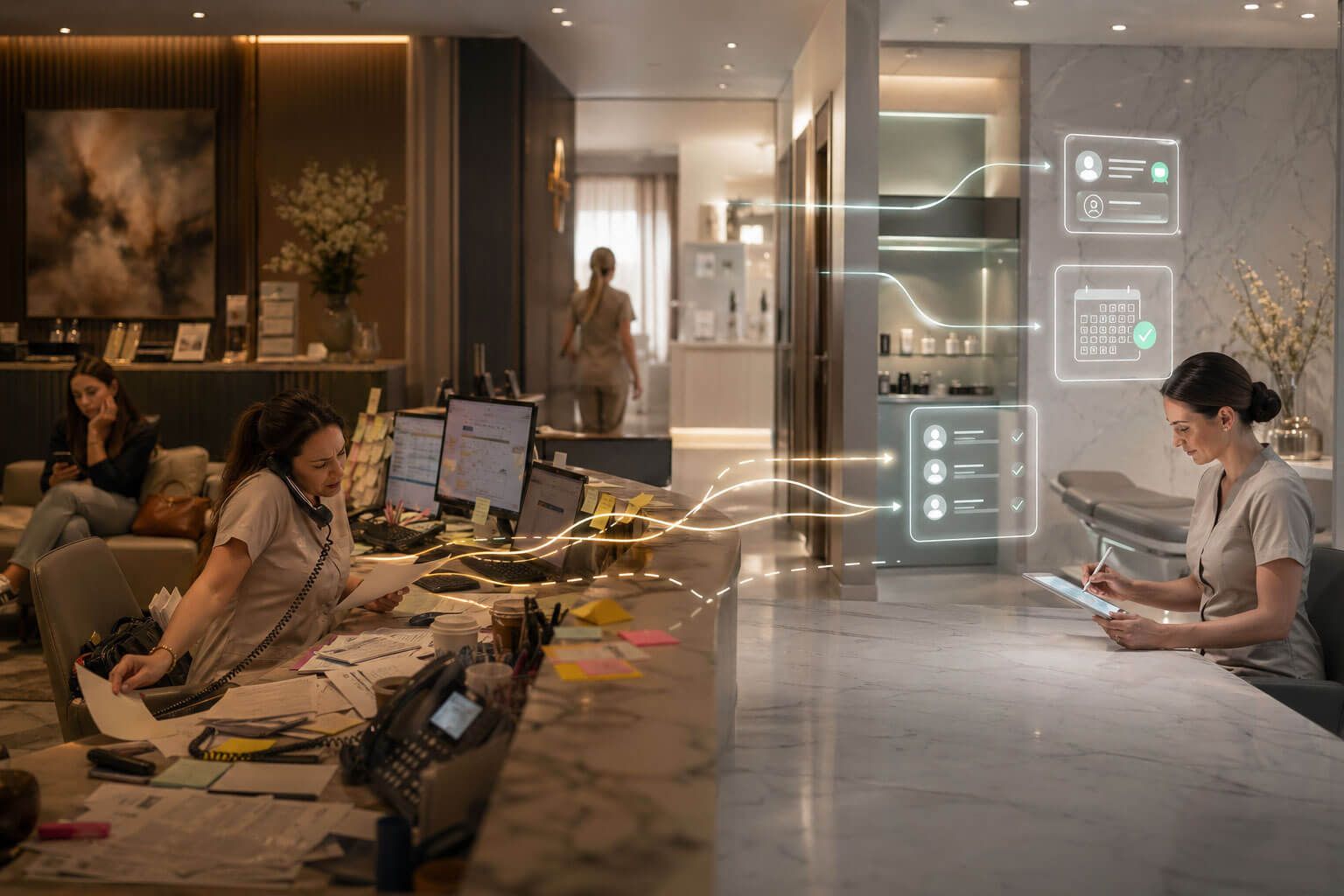
- Responding to enquiries manually via WhatsApp, email, or phone
- Following up leads inconsistently (or not at all)
- Confirming bookings and answering repetitive questions
- Managing patient communication without structured systems
The issue is not that these tasks exist.
The issue is that they do not scale.
The Invisible Revenue Leak
Most clinics don't lose money because of poor marketing — they lose it because of what happens after the enquiry.
Have you read how Ireland is promoting to get AI Ready, what AI Tools may help your clinic ROI and where is the sector headed in the age of AI Automation
Let's break this down in real terms.
A typical clinic might generate:
100 enquiries per month
If:
- response time is slow
- follow-up is inconsistent
- leads are not qualified properly
You may only convert 20–30% of those enquiries.
That means:
70–80 potential patients are lost
Not because they weren't interested — but because the system didn't capture them.
Where Manual Processes Cost You Money
1. Slow Lead Response
Patients today expect speed.
If your clinic takes hours, or worse, days, to respond:
- Leads go to competitors
- Interest drops quickly
- Trust is weakened before the first interaction
Even a small delay has a measurable cost.
2. Inconsistent Follow-Up
Most clinics rely on staff to "remember" to follow up.
That leads to:
- Some patients being chased, others forgotten
- No structured nurturing of undecided leads
- Lost opportunities from patients who needed more time
Follow-up is not optional.
It is where a significant percentage of revenue is recovered.
3. Staff Time Spent on Low-Value Work
Highly capable staff are often tied up doing repetitive tasks:
- Answering the same pre-treatment questions
- Manually confirming appointments
- Handling basic enquiries that could be automated
This creates two problems:
- inefficiency
- and limited capacity for growth
4. Fragmented Patient Experience
When communication is manual:
- Messaging varies depending on who responds
- Patients receive inconsistent information
- The overall experience feels less premium
In aesthetic medicine, trust and perception are everything.
Inconsistency quietly erodes both.
Turning Inefficiency Into Numbers
Let's make this visible.
Imagine:
- Average treatment value: $300
- 70 lost enquiries per month
That's:
→ $21,000 in potential monthly revenue not captured
Even if only a portion of those would convert:
- 10 additional patients = $3,000/month
- 20 additional patients = $6,000/month
- 30 additional patients = $9,000/month
This is not a marketing problem.
It's an operational one.
Why Clinics Don't See This
The biggest issue with inefficiency is that it's invisible.
It doesn't show up as:
- a broken system
- or a clear failure
It shows up as:
- "we're quite busy"
- "we could do with more patients"
- "staff are stretched"
- Leads are lost quietly
- Revenue leakage is gradual
- Opportunity cost compounds over time
What Replaces Manual Processes
The solution is not hiring more staff.
It's removing the dependency on manual handling altogether.
- Instant lead response instead of delayed replies
- Automated follow-up instead of memory-based chasing
- Structured communication instead of inconsistent messaging
- System-driven workflows instead of ad-hoc processes
This is where AI systems become valuable — not as tools, but as infrastructure.
From Inefficiency to Control
Clinics that remove manual processes gain:
- Faster response times across all enquiries
- Higher conversion from existing leads
- More consistent patient experience
- Greater capacity without increasing headcount
This is not about doing more work.
It's about removing friction from the work you already have.
AestuOS Your clinic's AI-first operating system, reduce admin, automate follow-up and convert more enquiries into booked patients.
AestOSFinal Thought
Manual processes don't just slow clinics down.
They quietly cap growth.
Most clinics don't need more leads.
They need to capture and convert the ones they already have — faster, more consistently, and without relying on human bandwidth.
Once that changes, the economics of the clinic change with it.