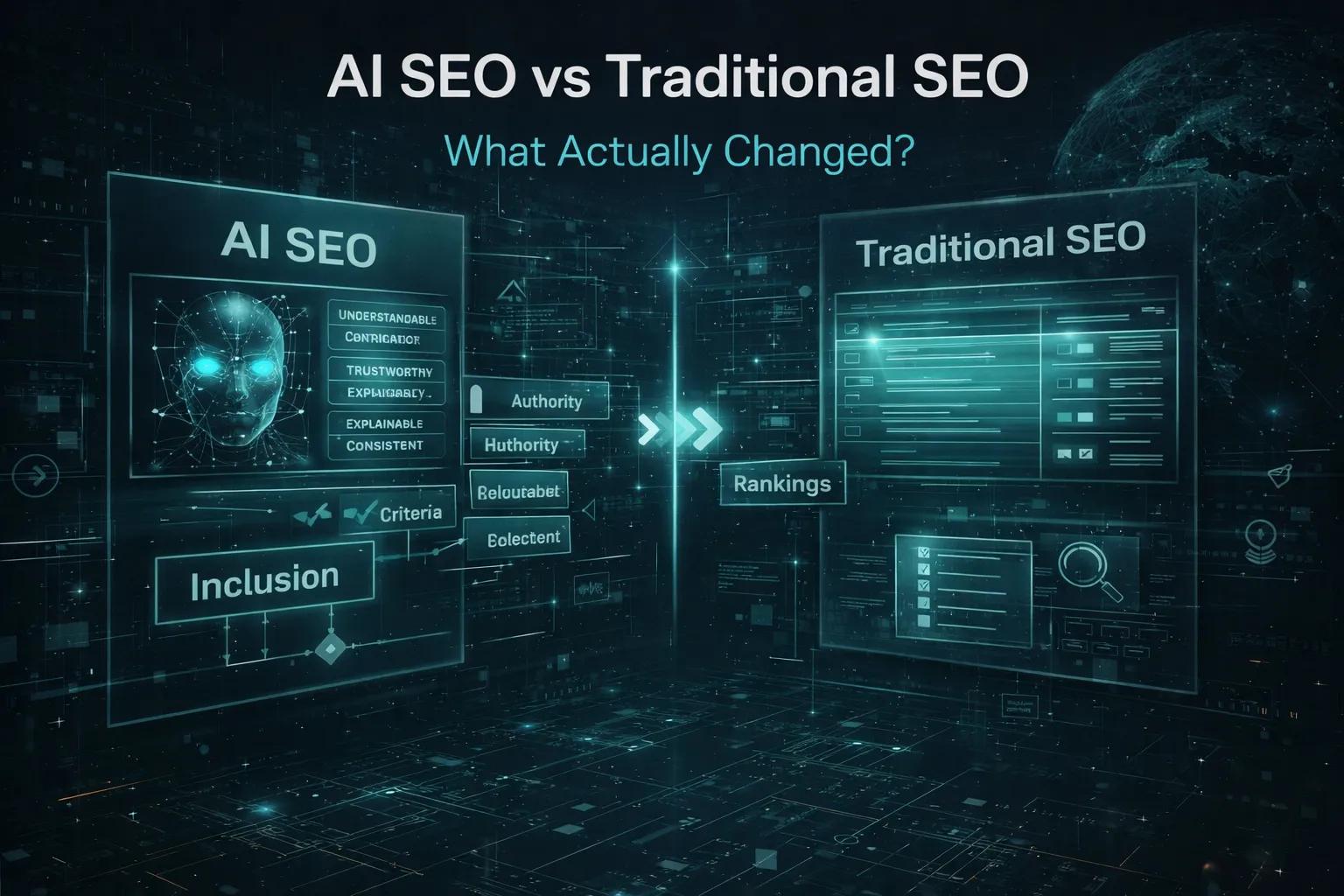
Why Google Rankings Alone No Longer Guarantee Patients for Clinics
Article highlights
- Ranking #1 organically now delivers 32% fewer clicks than a year ago; position 1 captures ~39.8% of clicks, position 2 gets 18.7%, position 3 gets 10.2%.
- Your Google Business Profile often matters more than your website for clinics; it appears above organic results and influences patient decisions before they visit your site.
- Google Business Profile success requires five elements: correct category alignment, NAP consistency, matching service descriptions, strong reviews, and high-quality visuals with active management.
- E-E-A-T (Experience, Expertise, Authoritativeness, Trustworthiness) is built externally through third-party validation, not on your website—reviews, professional affiliations, conference speaking, and industry recognition are what matter.
- For clinics classified as YMYL (Your Money or Your Life), trust signals and review keyword relevance are now stronger differentiators than ranking position alone.
The Shift Clinics Haven't Caught Up With
Most clinics still optimise primarily for:
- traditional Google rankings
- website visitors
- visual page design
Traditional search remains the main source of traffic today, but patient behaviour is evolving. More people are:
- asking AI tools for quick answers and recommendations
- receiving summarised shortlists
- making faster decisions with higher intent
Smart clinics are future-proofing by building clarity that performs well in both traditional search and emerging AI-assisted journeys. Early adopters gain a lasting edge.
You can think of this as future-proofing your business. While traffic from the likes of ChatGPT, Grok, etc, is small compared to search, it is growing every day. Being ready for when that traffic grows, being an early adopter, means one less thing to worry about as AI technology matures.
What "Getting Chosen" Actually Means
When someone asks:
"Who is the best clinic for Botox near me?"
"Where should I go for rhinoplasty in Dublin?"
Google and AI systems don't always show 10 blue links. They analyse information across the web, compare providers, and often surface a shortlist (or even a single strong recommendation) — frequently pulled from Google Business Profiles, reviews, and authoritative signals first.
If your website (and your overall online presence) lacks clear, structured, authoritative content, you never enter the shortlist — even if you rank well traditionally.
The Core Problem: Websites Built for Humans (and Old SEO), Not Modern Evaluation
Most clinic websites prioritise:
- visuals and branding
- general messaging
They often use vague claims like:
- "We offer high-quality treatments"
- "Expert care and personalised service"
- "Leading clinic in our field"
To a human skimming, that's acceptable. To AI systems and modern search evaluation, it's low-value and hard to trust or extract.
Problem 1: Vague Positioning
AI and search systems need to quickly understand:
- what you specifically do
- who you do it for
- how you differ from others
Many sites blur treatments, audiences, and expertise together with generic language.
What AI Sees:
"This could be any clinic"
What Works Instead:
- specific treatments with clear outcomes
- defined patient types (e.g., "Botox for busy professionals" or "rhinoplasty for men")
- focused expertise positioning
Problem 2: Mixed Intent Pages
Many pages try to serve every goal at once (education + selling + trust-building + keyword ranking). This creates long, unfocused content with mixed signals.
What AI Sees:
"Unclear what this page is primarily about"
What Works Instead:
- separate core explanation from conversion elements
- clear sections with defined purposes
- easy-to-extract answers
AI SystemsReady to make your website clearly understandable by both patients and AI?
Explore AI First →Problem 3: No Structured Content
AI systems rely heavily on:
- logical headings and hierarchy
- short, focused sections
- scannable flow
Many clinic sites rely on design over structure, burying key facts in dense paragraphs.
What AI Sees:
"Hard to interpret quickly — skip or summarise poorly"
What Works Instead:
- descriptive headings that answer questions
- short sections with direct answers
- bullet points and tables where helpful
(Consider adding schema markup like FAQ or Article schema to make facts even more extractable.)
Problem 4: Insufficient Contextual Depth
A single generic service page per treatment is no longer enough for deep topics.
AI looks for topical depth and contextual coverage.
Example (Botox):
Instead of one page, build supporting context such as:
- Botox for forehead wrinkles vs. crow's feet
- Botox for men — what to expect
- Botox vs. dermal fillers — key differences
- How Botox works and typical results
What AI Sees:
"This clinic demonstrates real understanding of the topic"
Problem 5: Repetitive, SEO-Driven Content
Old-school keyword tactics created near-duplicates and forced variations.
AI detects this quickly as low-value.
What Works Instead:
- genuinely distinct, context-specific pages
- natural semantic variation with real meaning
Problem 6: Weak Authority Signals (EEAT)
AI systems constantly evaluate: "Who should I trust with this advice?"
Most clinic sites don't make Experience, Expertise, Authoritativeness, and Trustworthiness obvious or verifiable. They lack:
- clear, consistent expertise positioning
- structured signals of real credentials and outcomes
- supporting content that demonstrates depth over time
What AI Sees:
"Uncertain or unproven authority"
What Works Instead:
- explicit, evidence-based expertise (tied to real-world signals)
- consistent messaging across the site
- content that builds topical authority
Note: True EEAT lives largely off-page (registrations, peer recognition, verifiable results, strong reviews) but must be clearly communicated and structured on your site and Google Business Profile.
The Bigger Issue: No Coherent System
Most clinic websites evolved as a collection of pages without an intentional architecture. AI and modern search see disconnected fragments instead of a clear, authoritative brand.
What Works: A Structured, AI-First Approach
Clinics that get selected and cited typically have:
1. Clear Core Pages
- focused on specific services and outcomes
2. Supporting Context Pages
- deeper explanations and patient scenarios
3. Consistent Language & Terminology
- repeated core concepts without unnecessary variation
4. Strong Technical Structure
- semantic HTML, clear headings, and schema markup
What This Means for Clinics
You don't necessarily need more pages or more traffic. You need more clarity, structure, and demonstrable authority — optimised for both today's Google search (including strong Google Business Profile performance) and tomorrow's AI recommendations.
The Real Competitive Shift
Clinics used to compete mainly for visibility in search results.
Now (and increasingly), they compete for selection and citation by both users and AI systems — often decided before anyone reaches the website.
Final Thought
AI and modern search don't reward the best-looking website or the most aggressively optimised page.
They reward the clearest, most understandable, and most authoritative clinic — one that makes it easy to see exactly what you do, who you help best, and why patients (and AI) can trust you.
Build that way — with a strong Google Business Profile, genuine EEAT signals, and clear site structure — and you don't just rank.
You get chosen.