Article highlights
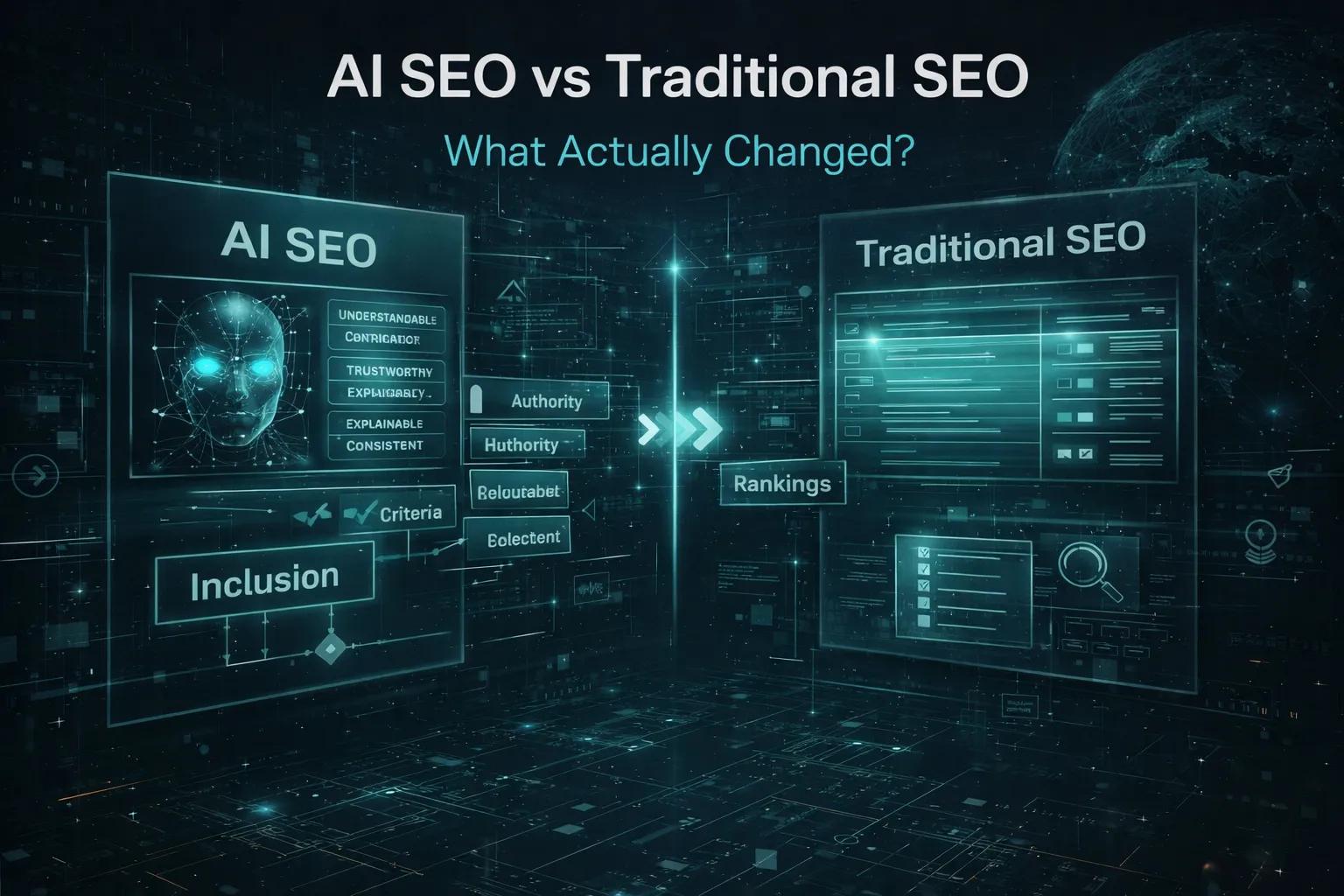
- Traditional SEO focuses on ranking pages to drive clicks using keywords, backlinks, and technical optimisation; AI SEO shifts the goal to being selected as the direct answer in AI responses.
- The user journey has changed from "search → click → browse" to "ask AI → get summarised answer → decide," so the priority is clarity and trustworthiness over visibility in result lists.
- AI prioritises clear explanations, structured content, consistent terminology, and context-specific relevance rather than keyword density or ranking position.
- Old tactics that no longer work well: long unfocused pages, repetitive/keyword-stuffed content, and mixing explanation with sales on the same page.
- New strategies: optimise for meaning, use clear headings and short sections, separate explanation (context) pages from conversion (sales) pages, and expand content with industry/use-case variations.
- For medical aesthetics clinics: focus on being the trusted source AI recommends — this leads to higher-intent patients who arrive pre-trust and closer to booking.
- Traditional SEO is still needed for discovery, but AI SEO determines actual selection.
The Old Model: Traditional SEO
Traditional SEO was built around a simple loop:
search → results → click → browse
To win, you needed:
- the right keywords
- enough backlinks
- technically sound pages
Success looked like:
- ranking position
- traffic volume
- click-through rate
The goal was:
get the click
The New Model: AI Search
AI changes the interaction completely:
ask → get an answer → make a decision
Users are no longer:
- comparing 10 links
- browsing multiple sites
- researching manually
Instead:
- AI summarises
- AI filters
- AI selects
The goal is no longer:
get the click
It is:
be the answer
You don't lose because you don't rank. You lose because AI doesn't understand you well enough to choose you.
The Core Difference
Traditional SEO
Optimises for:
- visibility in a list
AI SEO
Optimises for:
- selection as the answer
This is not a small shift.
It changes:
- how content is written
- how websites are structured
- how authority is built
What Traditional SEO Still Gets Right
It's not dead.
Traditional SEO still matters for:
- discovery
- indexing
- baseline visibility
Things like:
- technical SEO
- site speed
- crawlability
Still form the foundation.
But they are:
necessary, not sufficient
Where Traditional SEO Breaks
Traditional SEO struggles in AI environments because it often produces:
- long, unfocused pages
- keyword-heavy content
- duplicated variations of the same idea
- content written for ranking, not clarity
To AI, this looks like:
noise
What AI SEO Optimises For
AI systems prioritise:
- **clear definitions**
- **structured explanations**
- **consistent terminology**
- **context-specific relevance**
They are trying to answer:
"Which source explains this best?"
Not:
"Which page ranks highest?"
The Shift in Content Strategy
Traditional SEO Content
- built around keywords
- written to rank
- often repetitive
AI SEO Content
- built around meaning
- written to be understood
- structured for extraction
The Biggest Change: From Pages to Concepts
Traditional SEO focused on pages:
- one page = one keyword
AI SEO focuses on concepts:
- one idea = multiple structured explanations
- across different contexts
Example
Traditional approach:
- "Website design for clinics"
- "Clinic website design services"
- "Best clinic websites"
Multiple pages saying similar things.
AI-first approach:
- What is website design for clinics?
- Website design for aesthetic clinics
- Website design for cosmetic surgery
- Website design for medical practices
Same concept. Different context. Clear structure.
Why This Matters for Conversion
Traditional SEO separates:
- traffic
- conversion
AI collapses them.
When AI recommends you:
- the user already trusts the answer
- the decision is partially made
So when they land:
they are closer to action
The New Competitive Advantage
It's no longer:
- who ranks highest
It's:
who explains the clearest
What This Means in Practice
To compete in AI search, you need to:
1. Be Explicit
Say exactly what you do.
Avoid:
- vague positioning
- clever phrasing
2. Structure Your Content
Use:
- clear headings
- short sections
- direct answers
3. Separate Intent
Don't mix:
- explanation
- sales
Use:
- conversion pages
- context pages
Lead GenerationWant a consistent flow of new patients without relying on word of mouth?
See the Lead Factory →4. Expand by Context
Instead of duplicating pages:
- create variations based on real differences
- industries
- use cases
- scenarios
5. Stay Consistent
Repeat key concepts clearly across your site.
AI builds understanding through:
consistency, not creativity
Final Thought
Traditional SEO was about:
being found
AI SEO is about:
being trusted and selected
The websites that win won't be:
- the loudest
- or the most optimised
They'll be:
the clearest